
- Home
- Adhesive Tapes
- Self-adhesive Label
- Label Jumbo Roll
- Solutions
- About Us
- News & Insight
- Resources
- Contact Us

Views: 0 Author: Site Editor Publish Time: 2026-08-08 Origin: Site


Heavy-duty mounting tape failures do more than just frustrate you. They result in broken assets, costly property damage, and serious safety hazards in both commercial and residential environments. Unfortunately, standard marketing narratives often mislead consumers. Many commercial adhesives advertise extreme weight capacities, claiming to hold up to 50 pounds. However, manufacturers base these impressive numbers on ideal laboratory conditions. They test on perfectly flat, immaculate substrates using evenly distributed loads. These flawless environments rarely translate to your real-world applications. When you mount a shelf or secure outdoor signage, environmental variables change drastically. We must look past packaging claims. This article sets a clear purpose. We provide a technical, substrate-focused framework for evaluating and selecting the correct adhesive. You will learn how to choose a Double Sided Tape that guarantees long-term holding power without causing unnecessary surface damage.
Weight ratings are conditional: Maximum load capacities depend entirely on surface energy, temperature, and proper curing times.
Substrate dictates the material: Nano Acrylic Tape suits temporary glass mounting, while Foam Tape handles uneven surfaces, and VHB dominates permanent metal bonding.
Preparation is non-negotiable: Over 80% of adhesive failures stem from inadequate surface cleaning or ignoring the 72-hour bond-building window.
Shear vs. Tensile load matters: Tape performs differently when resisting a sliding downward pull (shear) versus a direct outward pull (tensile).
Most adhesive failures occur because consumers misunderstand laboratory weight ratings. Manufacturers test heavy-duty adhesives under strictly controlled conditions. They apply the material to flat, non-porous surfaces like stainless steel. They ensure perfect weight distribution across the entire bond area. You rarely replicate these ideal conditions in real life. If a package claims a 30-pound capacity, it means it holds 30 pounds of flat steel against flat steel. Real-world applications introduce uneven textures, leverage, and challenging angles.
You must differentiate between shear stress and cleavage stress to prevent accidents. Hanging a flat mirror against a wall generates shear stress. The gravitational force pulls straight down, parallel to the wall. High-quality adhesives handle shear stress exceptionally well because the load distributes evenly. Conversely, mounting a protruding shelf creates cleavage or peel stress. The shelf pulls outward and downward simultaneously. This leverage magnifies the force. It pulls the adhesive away from the top edge, causing premature failure.
Surface energy also dictates your mounting success. Think of surface energy like magnetism for adhesives. Materials like bare glass, aluminum, and polycarbonate possess high surface energy. Adhesives stick effortlessly to them. The liquid properties of the adhesive wet out and spread deeply into the microscopic pores. On the flip side, plastics like polyethylene, silicone, or coated drywall have low surface energy. Adhesives bead up and peel off easily. If you ignore surface energy, even industrial-grade formulas will peel away within hours.
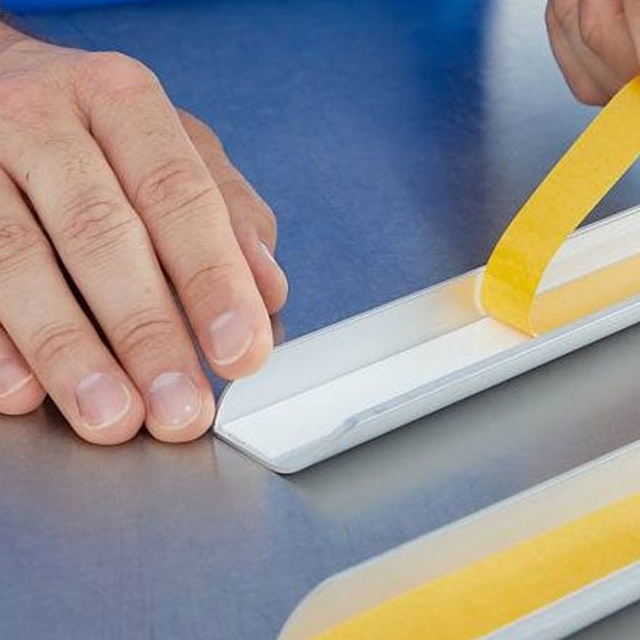
There is no universal mounting solution. Different chemical structures serve highly specific physical applications. You must match the material to your environment.
VHB represents the pinnacle of permanent adhesion. It relies on a unique closed-cell acrylic foam construction. The entire thickness of the material acts as an adhesive. It absorbs shock and vibration remarkably well.
Best for: Permanent, weatherproof outdoor mounting. Automotive trims, heavy signage, and metal-to-metal bonding rely heavily on it. It expands and contracts alongside metal during temperature changes.
Limitations: You will find it extremely difficult to remove. It will destroy painted drywall upon removal. Once cured, you usually need mechanical tools, heat guns, or harsh solvents to break the bond.
This option provides necessary thickness and compressibility. When you need to bridge physical gaps, you need a high-quality Foam Tape.
Best for: Textured walls, brick, and rough wood. The thick foam carrier compresses to fill microscopic gaps on uneven substrates. It creates maximum surface contact where ultra-thin adhesives simply hover over the bumps.
Limitations: It remains prone to degradation under high UV exposure. Extreme heat can melt the carrier. It frequently tears during removal, leaving a frustrating, sticky residue behind on your walls.
These transparent, thick gel strips recently gained massive popularity online. They function through micro-suction rather than traditional chemical bonding.
Best for: Temporary indoor mounting on smooth glass or tile. It works beautifully for renter-friendly applications. You can mount lightweight plastic frames without drilling holes. For these specific scenarios, Nano Acrylic Tape provides a clean, aesthetic finish.
Limitations: Washable and reusable claims degrade rapidly. Dust destroys the micro-suction effect immediately after the first use. It also fails quickly in high-moisture environments like steamy bathrooms.
This product features a rugged woven fabric carrier. Manufacturers coat this fabric heavily with aggressive rubber adhesives.
Best for: High-shear floor applications. You use it for securing area rugs, laying exhibition carpets, and bonding rough or fibrous textures. The cloth mesh prevents the material from stretching. A robust Cloth Tape handles immense horizontal foot traffic forces securely.
Limitations: It exhibits low tensile strength for vertical wall mounting. Gravity easily defeats it. Furthermore, the heavy rubber adhesive is highly susceptible to moisture damage.
You must evaluate three core dimensions before beginning any mounting project. Skipping this step leads directly to property damage.
First, assess environmental resilience. Consider your daily temperature operating ranges. Standard adhesives soften and fail above 120°F. If you mount a dashcam inside a hot car during summer, basic adhesives will melt. Direct sunlight on dark outdoor surfaces easily exceeds this threshold. You must select UV-resistant and heat-rated formulas for these punishing environments. Similarly, freezing temperatures cause standard adhesives to become brittle and shatter under stress.
Second, verify substrate compatibility. The adhesive must bond equally well to both materials involved. People often forget this critical rule. A specific adhesive might carry an excellent rating for outdoor brick walls. However, it may fail completely on the smooth, low-energy plastic backing of your security camera. You must ensure compatibility for both the wall and the object.
Finally, weigh removability against permanence. Evaluate your acceptable level of damage upon removal. You cannot have maximum holding power and damage-free removal simultaneously. This highlights a crucial inverse relationship. Adhesives featuring high instant tack often lack long-term shear strength. Conversely, structural adhesives build immense, long-lasting strength but ruin surfaces upon removal. Choose your priority carefully before pressing anything into place.
Even the highest quality adhesives fail if you apply them incorrectly. Professional installers follow strict, uncompromising protocols. Implementing these steps separates a lasting mount from a broken object.
Chemical surface preparation is mandatory. You must mandate the use of a 50/50 mixture of isopropyl alcohol and water. This safely removes invisible oils, skin oils, dust, and fingerprints. We warn strongly against using standard household cleaners. Products like Windex leave invisible anti-stick residues. These silicone or wax residues act as a barrier, preventing adhesion. Wipe the area thoroughly and wait until it dries completely.
Next, focus on application pressure. We are dealing with pressure-sensitive adhesives (PSAs). They require firm, continuous pressure to activate properly. You typically need to apply 15 to 20 PSI across the entire surface area. This pressure forces the viscous liquid properties of the adhesive to flow. It must seep into the microscopic pores of the substrate to lock in mechanically. Lightly pressing the object against the wall is never enough.
You must respect the curing timeline. Detail the critical bond-building phase before applying weight. Many users make the fatal mistake of loading weight immediately. Most heavy-duty formulas achieve only 50% strength after 20 minutes. They reach 90% strength in 24 hours. They require a full 72 hours to hit 100% maximum hold. The polymers need time to cross-link. Mounting heavy objects instantly invites guaranteed failure. Use painters tape to support heavy objects against the wall while the actual bond cures.
To simplify your decision, follow this conditional logic based on specific use cases. Matching the application to the correct chemistry guarantees better results.
For Permanent Outdoor or Metal Fixtures: Specify VHB acrylic formulas for maximum environmental resistance. They conquer extreme temperatures, driving rain, and heavy industrial vibrations effortlessly.
For Indoor Uneven Walls (Drywall/Wood): Recommend heavy-duty foam carriers. They fill gaps perfectly on textured surfaces. However, note the necessity of mechanical removal later. You will likely need a putty knife and adhesive remover.
For Glass, Tile, and Temporary Needs: Point to nano gel solutions for their clean release properties. This remains true provided the weight load is minimal and the room stays completely dry.
For Floor and Fabric Applications: Select heavy-duty cloth-backed options. They withstand constant foot traffic and severe horizontal shear forces better than any alternative.
Adhesive Category | Ideal Substrates | Best Application Scenario | Primary Limitation |
|---|---|---|---|
VHB Acrylic | Metal, Glass, Automotive Plastics | Permanent Outdoor Fixtures | Destroys painted drywall on removal |
Foam (PE/PU) | Brick, Rough Wood, Textured Drywall | Uneven Indoor Walls | Leaves sticky residue behind |
Nano Gel | Smooth Glass, Glazed Tile | Temporary Lightweight Mounting | Fails quickly in humidity |
Cloth / Carpet | Floors, Fabric, Concrete | Horizontal Flooring Applications | Poor vertical shear strength |
There is no universal "strongest" tape on the market. Success depends entirely on matching the correct adhesive chemistry to your specific material and environment. A product designed to hold metal automotive trim will fail miserably on an indoor textured carpet. Prioritize surface preparation above all else. Clean surfaces thoroughly and apply firm pressure. Most importantly, respect the mandatory 72-hour curing time before applying full weight loads. If you follow these practical guidelines rather than blindly trusting marketing weight ratings, your mounting projects will remain safe and secure.
A: Yes, it frequently damages painted drywall. High-strength adhesives bond tightly to the top layer of paint. When you attempt removal, the adhesive often pulls the paint and the underlying paper right off the gypsum board. Always use gentle heat to soften the bond before carefully peeling it away.
A: The safest method involves applying heat. Use a hair dryer or heat gun on a low setting to warm the area. This softens the acrylic polymers. Next, take a piece of dental floss or fishing line. Slide it behind the object and gently saw downward to cut the bond safely.
A: While marketed as washable and reusable, performance drops drastically after the first use. Washing removes surface dirt, but the micro-pores that create the suction effect often become permanently clogged or damaged. You can reuse it for very lightweight items, but do not trust it for heavy mounting.
A: Premature failure almost always stems from two critical errors. First, you likely skipped surface preparation, leaving invisible oils or household cleaner residue behind. Second, you probably mounted the heavy object immediately. Pressure-sensitive adhesives require a full 72 hours to reach 100% bond strength.
A: Temperature significantly impacts performance. Applying adhesive below 50°F causes the material to stiffen, preventing it from flowing into microscopic pores. Operating environments above 120°F can melt standard formulas, causing shear failure. Always apply at room temperature and check maximum operating ranges for outdoor use.


