
- Home
- Adhesive Tapes
- Self-adhesive Label
- Label Jumbo Roll
- Solutions
- About Us
- News & Insight
- Resources
- Contact Us

Views: 0 Author: Site Editor Publish Time: 2026-08-17 Origin: Site


Switching to sustainable packaging often introduces a critical supply chain risk: seal failure. You might find a seemingly perfect eco-friendly sealing option, only to discover it pops open during transit. Seal failure ruins customer trust. It damages goods. It disrupts your entire fulfillment process.
A tape degrading perfectly in a landfill is useless if it compromises your package security. Many companies assume eco-friendly packaging means accepting weaker bonds. This assumption is false. You do not have to sacrifice security for sustainability. By understanding the underlying physics of adhesion, you can maintain package integrity.
This guide provides a technical evaluation framework for selecting high-performance sustainable sealing options. We explore adhesive chemistry. We analyze substrate strength. We also examine how operational environments impact bond reliability. You will learn how to evaluate claims and implement testing protocols.
Not all "eco-friendly" labels guarantee performance; evaluate both the backing substrate and the adhesive formulation separately.
Water Activated Tape (WAT) and Kraft Tape offer the strongest bond for heavy-duty corrugated cartons by fusing with the box fibers.
Plant-based Cellophane Tape is a viable, high-tack alternative for lightweight packaging, but requires temperature-controlled storage.
Always match tape specifications (shear strength, initial tack) to your specific warehouse conditions (humidity, dust, temperature).
Verify claims through industry-standard certifications (e.g., PSTC guidelines, recognized compostability standards) to avoid greenwashing.
Packaging tape consists of two distinct components. You have the carrier, often called the backing. You also have the adhesive itself. Many brands mistakenly evaluate only the carrier. A supplier might use a highly sustainable paper backing. However, they pair this backing using weak, synthetic glues. This creates a severe component disconnect. You might purchase a product marketed as sustainable, but the adhesive fails to perform under stress. Evaluating a Degradable Tape requires assessing both layers equally.
Common failure points usually stem from poor initial tack. Modern fulfillment centers rely heavily on recycled corrugated boxes. Recycled cardboard features shorter, highly processed fibers. These shorter fibers generate microscopic dust on the box surface. Weak adhesives cannot penetrate this dust layer. The edges begin lifting almost immediately after application. You then face boxes popping open before they even leave your facility.
Warehouse humidity presents another massive challenge. Extreme transit temperatures compound the problem. Natural adhesives sometimes react poorly to moisture. A hot, humid warehouse can soften the glue. A freezing delivery truck can make the adhesive brittle. Both scenarios destroy the bond.
You must shift your evaluation mindset. Stop asking only if the product is green. Start asking if the product meets your specific shear and peel strength thresholds. You must ensure the product maintains strict degradability compliance while surviving your harshest supply chain conditions.
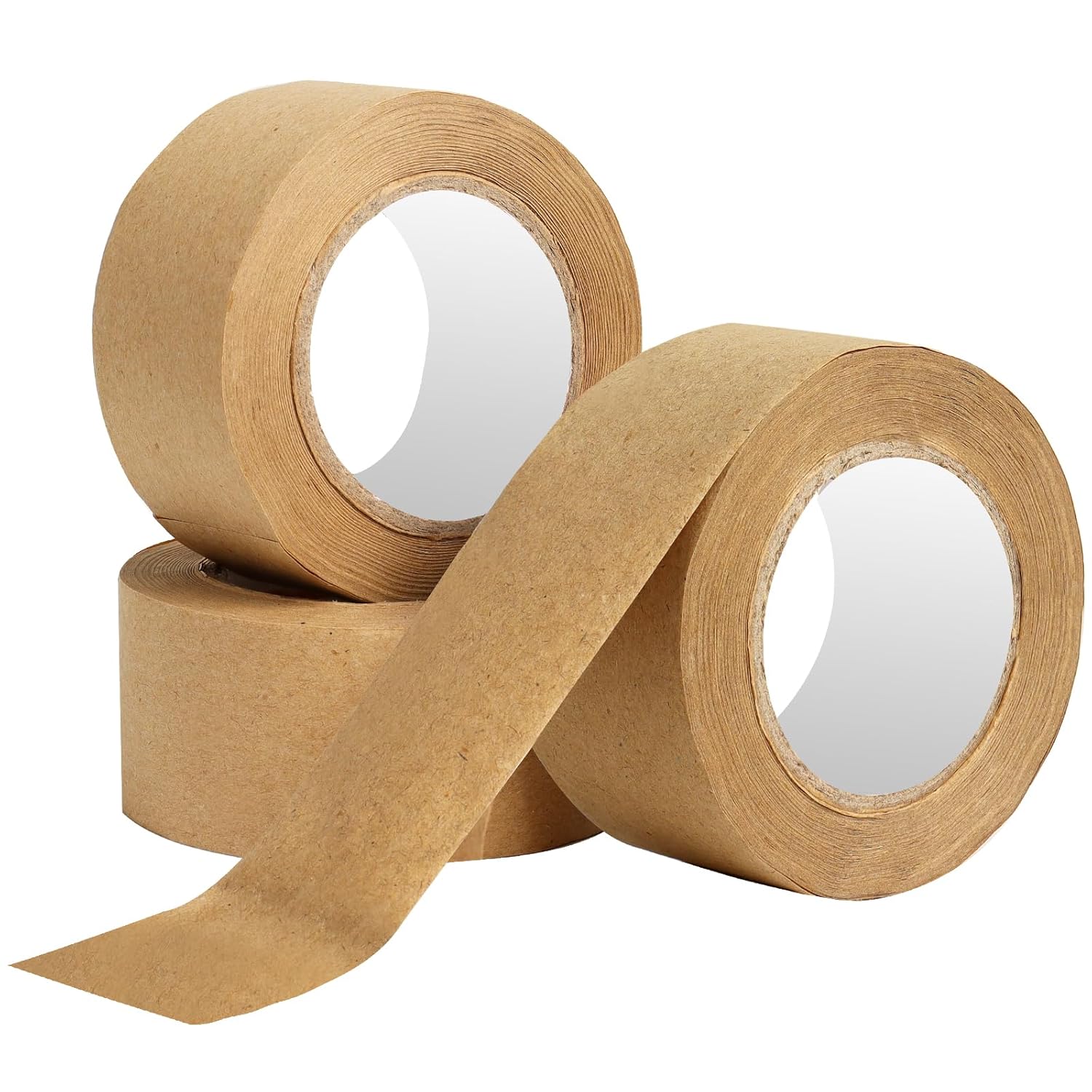
Selecting the right carrier and adhesive combination dictates your shipping success. Each material behaves differently under physical stress. You must align the material properties directly against your box weight and fulfillment volume. Below, we break down the three most common high-performance options.
This option creates a structural, tamper-evident bond. The adhesive requires moisture to activate. Once wetted, the glue penetrates the porous cardboard fibers. The tape and the box fuse into a single unit through capillary action. This bond becomes permanent.
Best For: High-volume, heavy-weight B2B and B2C shipping. It handles overstuffed cartons exceptionally well.
Drawbacks: You need specific dispensing machinery. You also need access to clean water. This drives up the initial setup cost.
This variant relies entirely on pressure-sensitive adhesives. Suppliers typically use natural rubber or hot melt formulations. The packer applies physical pressure to activate the bond. It requires no water and no complex machinery.
Best For: Medium-weight boxes and manual packing stations. It suits medium-volume fulfillment operations.
Drawbacks: Freezing environments can destroy the bond during application. Highly dusty surfaces prevent the adhesive from gripping the fibers.
This option uses a cellulose-based backing. Manufacturers typically pair it using natural rubber adhesives. It provides excellent optical clarity. You also get extremely high initial tack. It mimics traditional plastic packing tape perfectly.
Best For: Retail packaging, lightweight poly mailer alternatives, and cosmetic finishes. It works beautifully for smaller ecommerce parcels.
Drawbacks: The cellulose can become brittle over time. It offers much lower tensile strength than reinforced paper options.
Comparison of Eco-Friendly Sealing Solutions
Material Type | Bonding Mechanism | Ideal Box Weight | Key Limitation |
|---|---|---|---|
Capillary fiber fusion | Heavy (up to 50+ lbs) | Requires specialized water dispensers | |
Pressure-sensitive | Medium (up to 30 lbs) | Struggles in sub-zero application | |
Pressure-sensitive | Light (under 10 lbs) | Can become brittle during long storage |
Understanding technical adhesion metrics separates successful procurement from costly mistakes. A product feeling sticky on your thumb tells you very little. You need quantifiable metrics to predict transit survival.
Initial tack measures how quickly the adhesive grabs the surface upon contact. High initial tack prevents the edges from curling up immediately. However, initial tack does not guarantee a secure transit. Ultimate adhesion measures the bond strength after a full curing period. Natural adhesives often require 24 to 48 hours to reach ultimate adhesion. A tape might feel very sticky initially but fail a 48-hour hold test on corrugated cardboard.
Shear resistance measures the ability to resist slippage. Imagine an overstuffed box. The flaps constantly push upward against the seal. The tape experiences immense lateral stress. Low shear resistance causes the tape to slowly slide open. You must demand high shear values for heavy or bulky items.
You must match your adhesive to your specific cardboard type. High-recycled-content boxes pose a major challenge. Recycled fibers are short and densely packed. They create a smooth, dusty surface. You require highly aggressive adhesive formulations to penetrate these tight fibers. Virgin pulp boxes have longer, looser fibers. They accept adhesives much more easily.
You must evaluate two distinct temperature ranges. First, consider the application temperature. This is the climate inside your packing facility. Second, consider the service temperature. This is the climate inside the delivery vehicle. A natural rubber adhesive might apply perfectly at 70 degrees Fahrenheit. It might fail completely if left inside a freezing truck overnight. Evaluate humidity resistance equally carefully.
Adhesion Testing Metrics Summary
Metric | Definition | Testing Implication |
|---|---|---|
Initial Tack | Immediate grab strength upon contact. | Determines if edges will lift right after packing. |
Ultimate Adhesion | Maximum bond strength after curing. | Requires testing 48 hours post-application. |
Shear Resistance | Resistance to lateral slippage. | Crucial for overstuffed or heavy cartons. |
Service Temp | Surviving transit climates. | Must tolerate truck freezing or baking. |
The packaging industry struggles heavily regarding misleading marketing. Vague claims like "eco-friendly" or "green" mean absolutely nothing legally. You must demand strict chemical and legal distinctions from your suppliers.
First, clarify the terminology. Degradable simply means the material breaks down into smaller pieces over time. All materials eventually degrade. Biodegradable means microorganisms can consume the material entirely. Compostable is the strictest standard. It means the material breaks down in a specific timeframe, leaving no toxic residue behind. You should look for recognized compostability standards like ASTM D6400 or EN 13432.
Next, scrutinize the adhesive toxicity. Many companies use paper backing but coat it using petroleum-based glues. You want solvent-free formulations. Certain zero-waste programs and medical facilities require completely latex-free adhesives. Check for microplastic contamination. Synthetic adhesives often shed microplastics during the breakdown process. You must secure technical data sheets confirming a petroleum-free formulation.
Finally, rely on industry benchmarks to validate performance claims. The Pressure Sensitive Tape Council (PSTC) provides rigorous testing frameworks. Ask your supplier for their PSTC test results. PSTC-101 measures peel adhesion. PSTC-107 measures shear adhesion. Comparing PSTC data sheets removes marketing fluff. It gives you raw, standardized data.
Transitioning away from synthetic plastics isn't just a simple procurement swap. It impacts your entire fulfillment operation. Changing materials alters packer speed. It changes dispenser mechanics. It shifts how boxes handle warehouse storage. You must approach this transition systematically.
We recommend setting up a strict pilot test before rolling out new materials across your entire facility. A proper pilot exposes weaknesses before they impact your customers.
Conduct Drop Testing: Pack boxes using your heaviest standard items. Seal them using the proposed tape. Drop the boxes from waist height onto a concrete floor. Test flat drops, edge drops, and corner drops. Observe if the seal fractures or slips.
Perform Climate Stress Testing: Pack several test boxes. Place one batch in the hottest zone of your warehouse, near the ceiling. Place another batch near the coldest loading dock door. Leave them for 72 hours. Inspect the seals for curling, brittleness, or complete failure.
Test Substrate Compatibility: Apply the tape to the exact boxes you use daily. Do not test on pristine, virgin cardboard if you ship using dusty, recycled cartons. The test must reflect reality.
You must also factor equipment adjustments into your rollout plan. Adopting a water-activated solution requires automated dispensers. You have to train staff on cleaning the water brushes. If you choose a pressure-sensitive option, you must retrain your packers. Packers often gently wipe plastic tape. Natural rubber requires firm, downward pressure to activate the bond. If your packers do not apply sufficient pressure, the bond will fail. Include packer retraining in your deployment timeline.
Choosing the right sustainable sealing solution requires balancing environmental goals strictly against structural physics.
You must evaluate the backing material and the adhesive formulation as two separate elements to avoid greenwashing.
Match the specific tape type to your box weight, testing shear resistance and initial tack thoroughly.
Factor operational climates into your decision, ensuring the material survives both warehouse storage and transit temperatures.
Request technical data sheets (TDS) from suppliers immediately. Shortlist two to three options based on your box weight. Initiate a small-scale fulfillment pilot before committing to full adoption.
A: Yes, specifically Water Activated Tape and paper-based Kraft tapes usually repulp easily during the cardboard recycling process.
A: Yes. Because they use natural adhesives (like starch or natural rubber), they typically have a shorter shelf life (usually 6–12 months) and must be stored in climate-controlled environments.
A: Authentic cellophane is derived from wood pulp or cotton linters, making it a biodegradable, plant-based alternative to traditional plastic BOPP tape.
A: Yes, though many natural rubber adhesives contain latex. Starch-based water-activated adhesives or specific synthetic bio-based adhesives offer latex-free compliance for sensitive environments.


